
Failing to meet FDA vape labeling rules can lead to fines, product seizures, or worse. Here's what you need to know to stay compliant and keep your products on shelves:
- Nicotine Warning Text: Use the exact FDA-required statement: "WARNING: This product contains nicotine. Nicotine is an addictive chemical."
- Placement: Display warnings on both principal display panels (PDPs) of the packaging.
- Size: The warning must cover at least 30% of the PDP area.
- Font & Color: Use legible sans-serif fonts (e.g., Helvetica Bold, Arial Bold) with high-contrast black-on-white or white-on-black text.
- Manufacturer Info: Include the name, city, and state of the manufacturer, packer, or distributor with phrases like "Manufactured for" or "Distributed by."
- Net Quantity: Clearly state the product's net weight or volume in both metric and U.S. units.
- Nicotine Strength: Accurately list nicotine levels in mg/mL and avoid misleading terms like "light" or "mild."
- Child-Appealing Designs: Avoid cartoons, candy-like imagery, or playful language that could attract minors.
- No Misleading Claims: Do not use terms like "FDA approved" or claims suggesting reduced risk without proper authorization.
- Child-Resistant Packaging: Ensure all vape products have tamper-proof, child-resistant packaging as required by FDA standards.
Quick Tip: Regularly review FDA guidelines to avoid penalties and demonstrate a commitment to public safety. Proper labeling not only ensures compliance but also builds trust with your customers.
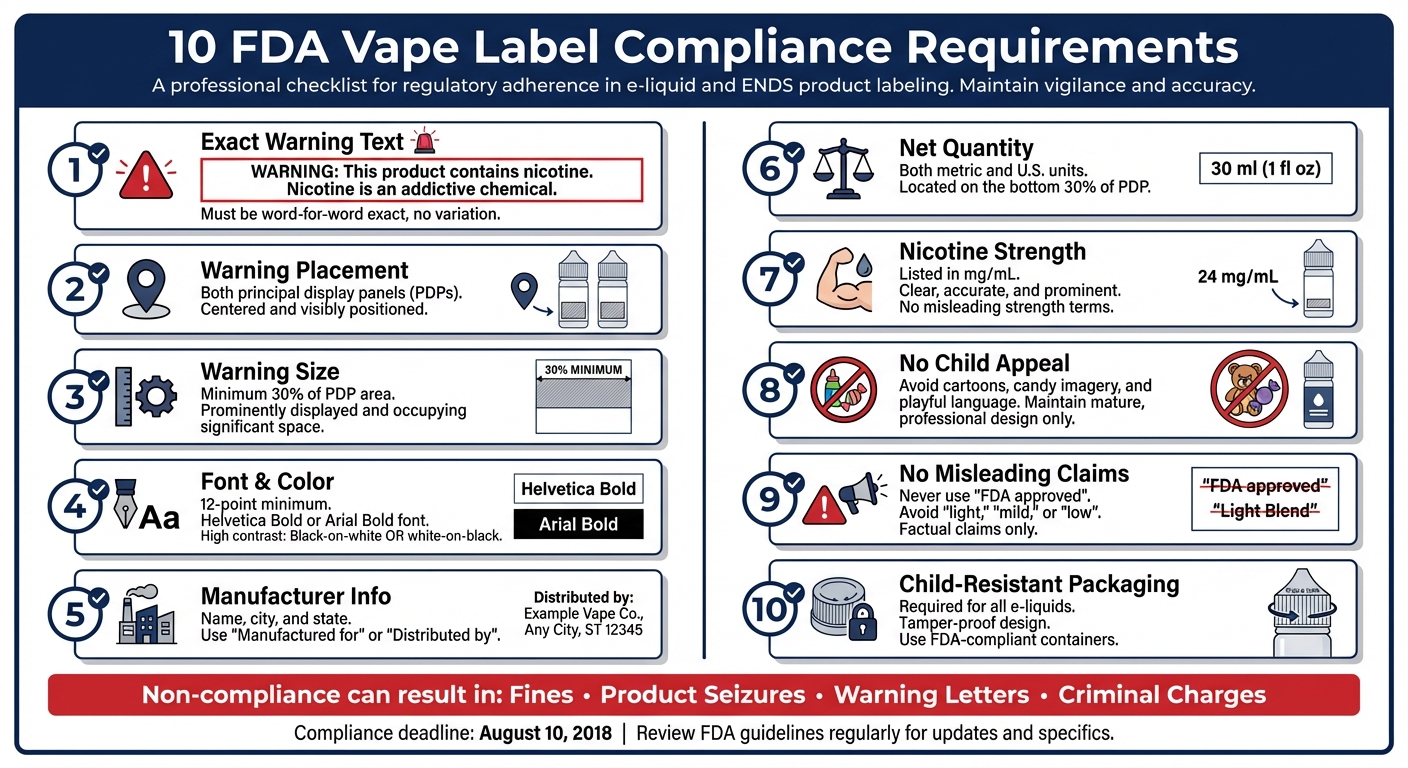
FDA Vape Label Compliance Requirements Checklist
Tobacco Product Compliance Policy: Updates for Manufacturers
1. Use the Exact FDA Nicotine Warning Text
Vape labels are required to display the following FDA nicotine warning text exactly as written:
"WARNING: This product contains nicotine. Nicotine is an addictive chemical."
This specific wording is mandated by federal regulation under 21 CFR §1143.3(a) for all covered tobacco products, including e-liquids, liquid nicotine, and electronic nicotine delivery systems. Every detail matters - punctuation, capitalization, and even the colon after "WARNING" must be precisely as stated. Any deviation from this format can result in your product being classified as misbranded under federal law.
Back in June 2019, the FDA and FTC issued joint warning letters to companies that failed to include this required warning in social media influencer posts. Dr. Ned Sharpless, Acting FDA Commissioner at the time, emphasized the importance of compliance:
"It's critical we ensure manufacturers, retailers, and others include the required health warning about nicotine's addictive properties on packages and advertisements – especially on social media platforms popular with kids."
- Ned Sharpless, M.D., Acting FDA Commissioner
Failing to comply with this regulation can lead to serious consequences, such as fines, product seizures, injunctions, and even criminal charges. For imported products, missing warnings may result in detention or outright refusal at the U.S. border. Since the compliance deadline of August 10, 2018, this rule has been fully enforceable, leaving no room for leniency.
2. Place Warning on Principal Display Panels
The FDA describes principal display panels (PDPs) as "the panels of a package that are most likely to be displayed, presented, shown, or examined by the consumer". These are the two outward-facing panels on your product's packaging.
To meet FDA guidelines, the nicotine warning must appear on both panels, ensuring it’s visible no matter how the package is positioned. The warning should be centered in its designated area and aligned with your brand name and key product details.
For smaller products like individual vape pods or mini bottles that lack space for the required warning, there’s an alternative. In such cases, the outer carton, wrapper, or a tag permanently attached to the package can serve as the principal display panel. This means temporary solutions like loose inserts or removable stickers won’t meet FDA standards. Even for compact products, this method ensures compliance.
Make sure the warning is clearly visible through any transparent coverings. Packaging materials must not obscure or distort the text in any way .
For advertisements - whether they’re in print, online, or on social media - the warning must be placed in the upper portion of the ad within the trim area. It should take up at least 20% of the total ad space . This placement guarantees the warning is prominent and one of the first things consumers see, rather than hidden at the bottom where it could go unnoticed.
3. Make Warning Cover at Least 30% of Panel Area
Getting the size of the warning right is just as important as using the correct text and placement. The FDA mandates that the nicotine warning must take up at least 30% of each principal display panel. This rule ensures that the warning is hard to miss for consumers.
To comply, calculate the total surface area of each principal display panel and dedicate 30% of that space exclusively to the warning. The warning text should be prominent - avoid cramming it into tiny print within the designated area. It’s essential that the warning stands out and is easy to read.
Position the warning in the center of its allocated 30% space, making sure it aligns with other product details and isn’t obstructed by transparent or decorative packaging.
The FDA’s enforcement actions between April 2018 and April 2019 highlight the consequences of falling short of this requirement. Products that don’t meet the 30% rule are labeled as "misbranded" under federal law, which can lead to serious penalties, including warning letters, fines, or even product seizures. Double-check your measurements to ensure compliance and avoid these risks.
4. Follow FDA Font Size, Type, and Color Requirements
The FDA has strict rules about how nicotine warnings should look, covering everything from font size to color. These warnings must be printed in at least 12-point font, and the text should take up as much of the designated warning space as possible. This ensures the message is clear and hard to miss.
When it comes to font choice, the FDA recommends Helvetica Bold, Arial Bold, or similar sans serif fonts. These fonts are easy to read and meet the agency's standards. Avoid using decorative or script fonts, as they can make the warning harder to read and may not comply with FDA rules.
The FDA provides specific instructions regarding typeface and layout:
"Be printed in conspicuous and legible Helvetica bold or Arial bold type or other similar sans serif fonts and in black text on a white background or white text on a black background in a manner that contrasts by typography, layout, or color, with all other printed material on the package." – FDA
Color contrast is another key requirement. The warning must use black text on a white background or white text on a black background. This sharp contrast ensures the warning is visually distinct from the rest of the packaging. Additionally, the text should be centered and aligned with the other information on the principal display panel. It’s important to avoid tilting, rotating, or angling the text - keeping it straight and properly oriented enhances visibility and compliance with FDA guidelines.
5. Include Manufacturer, Packer, or Distributor Information
Federal law mandates that every vape product package must display the name and location of the manufacturer, packer, or distributor. This rule is essential for ensuring product traceability, allowing both regulators and consumers to quickly identify the source of any problems.
The FDA takes a broad view of what constitutes a "manufacturer." If you mix, modify, or relabel vape products, you fall under this category and must register with the FDA. As the agency puts it:
"If you make, modify, mix, manufacture, fabricate, assemble, process, label, repack, relabel, or import any tobacco product, then you are considered a tobacco product manufacturer." – FDA
Your label must include at least the city and state of your business location. If you're listing a distributor instead of the actual manufacturer, you need to use phrases like "Manufactured for" or "Distributed by" to clarify the roles. Additionally, to meet federal requirements, include the statement: "Sale only allowed in the United States".
Ensure this information is clear and easy to find. Avoid letting it get overshadowed by other design elements or hidden near the nicotine warning label. Providing accurate and visible details not only ensures accountability but also supports compliance with FDA regulations.
sbb-itb-5630951
6. Display Net Quantity by Weight or Volume
To comply with Section 903(a) of the Federal Food, Drug, and Cosmetic Act, every vape product package must clearly state its net quantity by weight or volume. Failing to include this information can result in the product being classified as misbranded, leading to potential recalls, fines, or even seizures. Let’s break down the specifics of how this information should be displayed.
The net quantity statement must be positioned on the Principal Display Panel (PDP), specifically within the bottom 30% of the panel, and aligned parallel to the base. It’s essential to include both metric units and U.S. customary units. For example, for e-liquids, you might label it as "30 ml (1 fl oz)", or for solids, "15 g (0.53 oz)." This dual-unit approach ensures compliance with federal requirements.
When listing the net quantity, only include the consumable product - do not factor in the weight of the packaging. Accurate tare weight calculations are important here. The font size for the net quantity statement depends on the size of your PDP. For instance, if your PDP measures between 5 and 25 square inches, the text must use letters that are at least 1/8 inch tall.
Avoid using phrases like "jumbo 60ml" or "full 1oz", as the FDA explicitly bans exaggerated or misleading descriptions. The statement should be clear, bold, and high-contrast to ensure readability. With 94% of consumers favoring brands that prioritize transparency, accurate and straightforward net quantity labeling not only fulfills legal obligations but also strengthens consumer trust.
7. Show Nicotine Strength Clearly
Displaying nicotine strength accurately isn't just a good practice - it's a legal requirement under the Federal Food, Drug, and Cosmetic Act. Misleading or incorrect nicotine strength labels can classify products as misbranded, which could lead to recalls, fines, or even product seizures. For e-liquids, nicotine strength should be listed in milligrams per milliliter (mg/mL) - for instance, "6 mg/mL" or "12 mg/mL" - to help consumers compare products easily and make informed choices. Just like warning labels and other essential details, clarity here is key to staying compliant with regulations.
Make sure nicotine strength is prominently displayed on the principal display panel. Use high-contrast colors, and ensure it stands out without being obscured by logos or design elements. Beyond meeting legal obligations, clear labeling plays a vital role in consumer safety.
"Counterfeit devices often exhibit inconsistent nicotine levels, contaminations, or defects." – Bolu Abe-Lathan, PA-C, Duke Smoking Cessation Program
Proper labeling helps users control their nicotine intake, reducing the risk of unintentionally increasing dependence. Additionally, consider indicating whether your product contains nicotine salts or freebase nicotine. Nicotine salts are absorbed more quickly and deliver a faster effect. Some brands also include descriptors like "Low", "Regular", or "Strong", but avoid terms such as "light" or "mild" unless you have an FDA Modified Risk Tobacco Product order.
If you sell zero-nicotine e-liquids designed to be mixed with nicotine, remember that these may still fall under FDA regulations as components or parts of tobacco products. Ensure the nicotine strength listed on your label matches the actual content to avoid misbranding issues.
8. Avoid Child-Appealing Images or Language
To stay in line with FDA regulations, it’s crucial to avoid any design elements that might appeal to minors. This means steering clear of cartoons, candy-like imagery, or playful language that resembles kid-focused products. For example, in July 2020, the FDA issued warning letters to companies using cartoon characters and food-like designs on e-liquid packaging. Similarly, in May 2018, labels and product names that evoked children’s treats - like "One Mad Hit Juice Box", "Vape Heads Sour Smurf Sauce", and "Twirly Pop" - also drew FDA warnings. These cases serve as clear examples of what not to do when designing your packaging.
"The warning letters were sent to companies marketing e-liquids that imitate packaging for food products that are often marketed and appeal to youth, such as cereal and soda, or feature kid-friendly cartoon characters such as unicorns." – FDA
Some specific design elements to avoid include:
- Bright, neon colors that resemble candy or juice packaging.
- Packaging shapes that mimic food or drink items, like juice boxes.
- Product names that reference popular cereals or sweet treats.
The importance of these guidelines becomes even clearer when you consider that 1.63 million middle and high school students in the U.S. used e-cigarettes in 2024. Protecting youth is a top priority.
Instead, aim for mature and refined designs. Opt for limited color palettes, clean typography, and professional imagery that resonate with adult consumers. Consider tech-inspired designs featuring geometric shapes or abstract art rather than literal flavor illustrations. Not only does this approach keep you compliant, but it also builds credibility with your adult audience while reducing the risk of regulatory actions, such as a Marketing Denial Order. Thoughtful, adult-oriented designs help you stay on the right side of the law and maintain trust with your customers.
9. Remove Misleading Claims Like 'FDA Approved' or 'Light'
Stick to factual and accurate claims when labeling vape products, following strict guidelines for both content and presentation. Avoid terms like "FDA approved", "light", "mild", or "low" on vape labels. These phrases are considered modified risk claims and are only allowed if supported by a Modified Risk Tobacco Product (MRTP) order - which is exceedingly rare. The use of "light", "mild", or "low" descriptors was prohibited for manufacturers starting November 8, 2017, and all distribution of such products ceased by December 8, 2017.
The term "FDA approved" is another one to steer clear of, as it can lead to compliance issues. While the FDA may authorize certain e-cigarette products for marketing, this does not equate to an endorsement of their safety. As of late 2025, only 39 e-cigarette products have received authorization for legal sale.
"While these products are authorized to be sold in the United States, it does not mean these products are safe, nor are they 'FDA approved.' All tobacco products are harmful and potentially addictive." – FDA
To align with current labeling rules, carefully review your packaging. Remove any wording that implies reduced risk or FDA endorsement. If your product is authorized, you may state "FDA authorized" but must also include the required nicotine addictiveness warning. Misleading language can lead to penalties and misbranding violations.
10. Use Child-Resistant Packaging
Child-resistant packaging isn’t just a good idea - it’s a strict FDA requirement for all e-liquid containers and vape products. The FDA oversees the packaging of all Electronic Nicotine Delivery Systems (ENDS), which means your product must include safeguards to prevent children from accidentally accessing nicotine. This is critical, as even small amounts of nicotine can lead to severe poisoning. Ensuring compliance with this regulation is a key part of your PMTA (Premarket Tobacco Product Application) submission.
When submitting your PMTA, you’ll need to prove that your packaging is "appropriate for the protection of the public health" (APPH). This involves demonstrating that your containers minimize the risk of accidental exposure, particularly for children and other non-users. Failing to meet these standards can result in delays or outright denial of FDA marketing authorization.
"FDA regulates the manufacture, import, packaging, labeling, advertising, promotion, sale, and distribution of ENDS and their components. This includes e-liquids, vials that contain e-liquid, cartridges, flavors, certain batteries, and even software." – FDA
The FDA has even issued an Advance Notice of Proposed Rulemaking specifically focused on child-resistant packaging for liquid nicotine and nicotine-containing e-liquids. This highlights how seriously the agency takes this issue. Even vape shops that mix or alter e-liquids are treated as tobacco manufacturers and must meet the same safety standards.
Your PMTA should include scientific evidence that backs up the child-resistant nature of your packaging. It’s essential that your containers are sealed as finished products, ready for consumer use, with protective features intact. Products distributed without these safeguards for further manufacturing won’t meet FDA requirements.
Conclusion
Navigating the complexities of FDA-compliant vape labeling requires ongoing attention. It's essential to keep your labels aligned with the FDA's evolving definitions, including those related to synthetic nicotine. Failing to do so could result in your products being classified as "misbranded" or "adulterated", which can lead to warning letters, fines, product seizures, or even injunctions.
The FDA's enforcement efforts highlight the serious consequences of non-compliance. As the agency puts it:
"FDA is committed to working quickly to transition the current marketplace to one in which all tobacco products have undergone a careful, science-based review by the agency and have met the statutory standard".
To steer clear of penalties, it's crucial to follow these guidelines closely. Regularly review and update your product labels, registrations, and listings to stay compliant. Set reminders to check the FDA's Tobacco Products guidance page, as the agency frequently updates its recommendations based on new research and shifting enforcement priorities. Keep in mind that FDA guidance reflects the agency's "current thinking" and may change as regulations evolve.
Beyond avoiding penalties, accurate and compliant labeling fosters trust with your customers. When your products display proper warnings, clear nicotine strength details, and accurate manufacturing information, you're showing a commitment to transparency and public health. For instance, required warning statements must cover at least 30% of each principal display panel.
Ultimately, compliance safeguards both your business and your customers. Staying informed, updating your labels regularly, and prioritizing safety and transparency are essential steps for success.
At Fresh Farms E-Liquid, we take pride in meeting these standards, ensuring a safe and transparent vaping experience for all our customers.
FAQs
What happens if vape labels don’t comply with FDA regulations?
Non-compliance with FDA vape labeling rules can lead to serious penalties. These include warning letters, civil fines that can surpass $20,000, and even product seizures. In extreme cases, the FDA might escalate enforcement actions, potentially causing significant disruptions to your business.
To steer clear of these issues, make sure your vape product labels adhere to all FDA requirements. This means providing accurate ingredient details, including the necessary warnings, and following the proper packaging guidelines.
What steps can I take to make sure my vape labels don’t appeal to children?
To keep your vape labels from drawing the attention of children, stick to clean, professional fonts and subdued colors that create a mature, adult-focused look. Steer clear of cartoon characters, candy-like visuals, or playful graphics that might appeal to younger audiences. Make sure to prominently feature the mandatory nicotine warning - this warning must cover at least 30% of the primary display panel, use a high-contrast design, and adhere to the required font size guidelines. Following these steps ensures your brand remains credible and helps you steer clear of potential fines.
What are the FDA labeling requirements for vape product packaging?
To meet FDA regulations, vape product packaging needs to display specific information. This includes a clear warning statement about nicotine's addictive properties, a detailed list of ingredients, the manufacturer's or distributor's name and address, and the nicotine content expressed in milligrams or as a percentage. Packaging must also steer clear of misleading claims or imagery that might appeal to minors.
Keeping up with the latest FDA guidelines is crucial for ensuring your labels remain compliant and avoid fines. Accurate labeling not only helps you stay within the law but also shows your commitment to customer safety and honesty.


