
Tobacco vape flavors replicate the taste of tobacco through two primary methods: synthetic compounds crafted in labs or naturally extracted flavors (NET) from real tobacco leaves. The process involves selecting raw materials, extracting flavor compounds, blending ingredients, and ensuring strict quality control. Here's a quick breakdown:
- Synthetic Flavors: Lab-created for consistency and precision, often used for unique blends like fruit-infused tobacco.
- NET Flavors: Extracted from real tobacco leaves using methods like cold maceration or CO₂ extraction for a rich flavor.
- Base Composition: E-liquids use a mix of vegetable glycerin (VG) and propylene glycol (PG), typically in a 50/50 ratio, to balance flavor, throat hit, and vapor production.
- Nicotine Options: Freebase nicotine offers a harsher throat hit, while nicotine salts provide a smoother experience.
- Flavor Enhancements: Additives like vanilla, bourbon, or menthol are often used to create layered profiles.
This process ensures a satisfying vaping experience while maintaining high safety and quality standards.
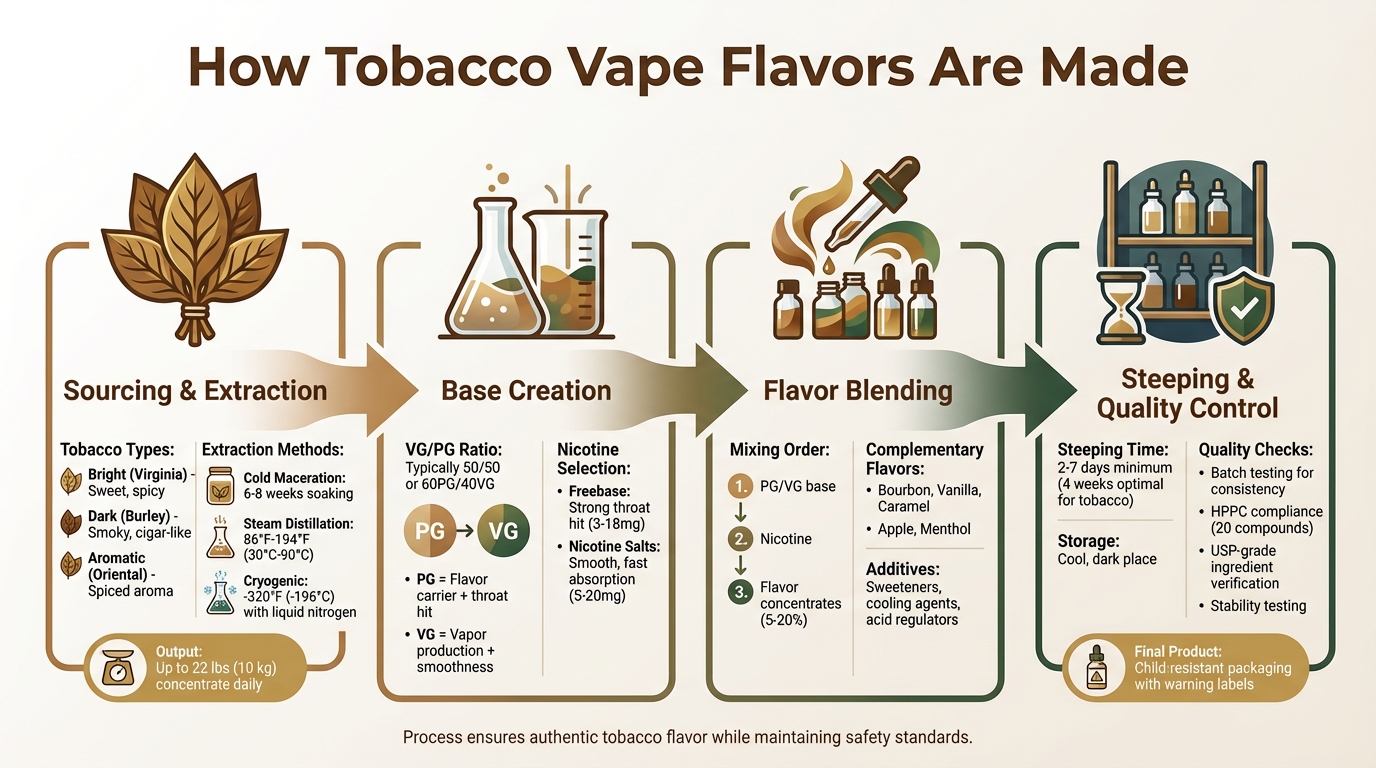
How Tobacco Vape Flavors Are Made: 4-Stage Manufacturing Process
Sourcing and Extracting Tobacco Flavor
Raw Materials for Tobacco Flavoring
Crafting authentic tobacco vape flavors starts with selecting the right raw materials. Manufacturers typically rely on three main types of tobacco: Bright (Virginia) tobacco, which is flue-cured and known for its spicy, sweet profile due to high sugar content; Dark (Burley) tobacco, which is air-cured and delivers smoky, cigar-like notes; and Aromatic (Oriental) tobacco, prized for its essential oils and spiced aroma. These leaves must be properly dried and aged to develop their signature aromas before the extraction process begins.
To enhance the tobacco profile, natural additives like cocoa, licorice, honey, and sucrose are often used. These ingredients help smooth out harsh flavors and create a richer, more rounded taste. Synthetic compounds, such as pyrazines for nutty or chocolate notes, vanillin for a hint of vanilla sweetness, and aldehydes for fruity or candy-like undertones, are also incorporated to achieve a balanced and complex flavor. Once the raw materials and additives are prepared, the extraction process transforms them into concentrated flavors ready for e-liquid production.
Extraction and Flavor Development Methods
The process of turning raw tobacco into concentrated flavor involves several methods, each with its own advantages. Cold maceration is widely regarded as the gold standard for premium e-liquids. This method involves soaking tobacco leaves in a solvent for six to eight weeks, allowing the delicate flavor compounds to infuse without introducing bitterness from heat. Though it’s time-consuming, cold maceration captures the pure essence of the tobacco leaf.
For larger-scale production, manufacturers often use steam stripping and distillation. In this process, tobacco is heated in conditioning chambers at temperatures between 86°F and 194°F (30°C–90°C), releasing volatile organic compounds (VOCs) that are then collected and condensed. A medium-sized facility can recover up to 22 pounds (10 kilograms) of pure tobacco concentrate daily using this method. Some manufacturers take it a step further with cryogenic condensation, cooling emissions to as low as -320°F (-196°C) with liquid nitrogen to capture even the most volatile flavor elements.
"A direct conditioning cylinder treatment can be assimilated to tobacco steam stripping, some sort of distillation process, in which the different types of tobacco... are treated separately." - Philip Morris Products SA
After extraction, the liquids are filtered through fine (5-micron) filters to remove any debris while retaining the flavor. Extracts from different tobacco types are typically processed separately, allowing manufacturers to blend them into specific recipes that replicate the nuanced profiles of traditional cigarettes or cigars.
Natural vs. Artificial Tobacco Flavors
Once the extraction is complete, manufacturers decide between using natural or artificial processes to create the final flavor profile. Naturally Extracted Tobacco (NET) flavors are made directly from real tobacco leaves through physical extraction methods. These flavors are known for their authentic and intricate profiles, though they require significant time and resources - cold maceration alone can take up to eight weeks. Additionally, natural extracts can vary slightly between batches, influenced by factors like the tobacco crop and curing process.
Artificial tobacco flavors, on the other hand, are created in laboratories through chemical synthesis. These flavors are cost-effective, consistent, and standardized, making them a popular choice for large-scale manufacturing. While they offer uniform quality and reliable supply, they often lack the depth and complexity found in natural extracts.
"While most early products contained natural flavours... the increasing demand of the tobacco industry for standardized flavourings and the limited supply from natural sources prompted suppliers to develop and optimize chemical synthetic processes to deliver bulk amounts." - World Health Organization Technical Report
Both approaches have their strengths. Natural extracts appeal to vapers who value authenticity and complexity, while artificial flavors offer consistency and accessibility, making them ideal for everyday use.
sbb-itb-5630951
Creating the Tobacco E-Liquid Base
The process of crafting a tobacco e-liquid base is all about preserving the rich, authentic essence of tobacco while ensuring a satisfying vaping experience.
Choosing the Right VG/PG Ratio
The ratio of vegetable glycerin (VG) to propylene glycol (PG) plays a crucial role in how tobacco e-liquids deliver flavor, throat hit, and vapor production. PG, a thinner and flavor-neutral liquid, excels at carrying nicotine and flavor concentrates, while VG, thicker and naturally sweet, is responsible for creating dense vapor clouds. For tobacco e-liquids, a 50VG/50PG ratio is often the go-to choice. This balanced mix offers a harmonious blend of flavor, throat hit, and vapor production.
However, many manufacturers lean toward higher PG ratios (e.g., 60PG/40VG) for tobacco blends. Why? PG enhances flavor delivery and mimics the sharp "throat hit" of smoking, which appeals to former smokers seeking a familiar sensation. On the other hand, high-VG blends, while producing larger clouds, can sometimes dull the intricate tobacco notes. Additionally, VG's natural sweetness might clash with the robust, savory nature of tobacco flavors.
Device compatibility is another factor to consider. E-liquids with a 50/50 or high-PG ratio are ideal for low-wattage Mouth-to-Lung (MTL) devices, particularly those with coil resistances between 1.0 and 2.0 ohms. High-VG liquids, being thicker, can clog smaller coils and cause dry hits.
Once the VG/PG ratio is set, the next step is selecting the nicotine type to tailor the vaping experience further.
Selecting Nicotine Type and Strength
The type of nicotine used in tobacco e-liquids significantly impacts the overall experience. Freebase nicotine, the purest form, is typically suspended in PG. It delivers a strong "throat hit", closely resembling the sensation of smoking traditional cigarettes. This makes it a top choice for those seeking an authentic tobacco experience. Alternatively, nicotine salts, created by combining nicotine with an organic acid, offer a smoother inhale, even at higher concentrations, and are absorbed more quickly into the bloodstream.
Nicotine strength is usually chosen based on smoking habits:
- 3mg: Casual smokers
- 6mg: Light smokers (around one pack per week)
- 12mg: Average smokers (about one pack per day)
- 18mg to 20mg: Heavy smokers (more than 20 cigarettes daily)
In regions like the UK and Canada, the legal nicotine limit is capped at 20mg/mL.
| Feature | Freebase Nicotine | Nicotine Salts |
|---|---|---|
| Throat Hit | Strong/Harsh (increases with strength) | Smooth (even at high strengths) |
| Absorption Rate | Slower | Faster/Immediate |
| Best For | Low to medium strengths; realistic smoking feel | High strengths; quick craving satisfaction |
| Common Strengths | 3mg, 6mg, 12mg, 18mg | 5mg, 10mg, 20mg |
"Freebase nicotine is versatile, but comes with a throat-hit when inhaled. This is sought-after by some new vapers as it more closely replicates the experience of smoking a cigarette." - LiQuid
Blending Tobacco with Complementary Flavors
Once the VG/PG ratio and nicotine are determined, the next step is enhancing the tobacco base with complementary flavors. Tobacco serves as the core, but additional notes like bourbon, vanilla, caramel, apple, or menthol can create a more complex and layered profile. The intensity of these added flavors varies, with concentrates ranging from 5% for subtle undertones to 20% for bolder blends.
Precision is key during mixing. Professional manufacturers rely on scales to ensure consistency across batches when combining PG, VG, nicotine, and flavor concentrates. Additional ingredients like sweeteners, cooling agents, and acid regulators can further refine the taste and mouthfeel. After mixing, the e-liquid needs to steep in a cool, dark place for 2 to 7 days to allow the flavors to meld and mature. Using heat to speed up this process is discouraged, as it can introduce bitterness and compromise the delicate tobacco notes.
"Vegetable glycerin (VG) in vaping fosters dense vapor... and provides a smoother inhale than propylene glycol (PG), catering to those preferring a gentler throat hit." - Hangsen
Mixing, Blending, and Steeping Techniques
Once you've established the base components for your tobacco e-liquid, the real art lies in mixing, blending, and steeping. These steps require precision and patience to create a flavor that’s not just good but truly satisfying. From the order of ingredients to the time you allow flavors to mature, every detail plays a role in shaping the final product.
Mixing Ingredients in the Right Order
The sequence of mixing might seem trivial, but it’s actually crucial. Start with your PG/VG blend. This ensures a smooth base for dissolving all other components effectively. Next, if you’re adding nicotine, it should go in after the base. As Decadent Vapours explains:
"Nicotine has a taste of its own, so adding more to an e-liquid mix can alter the flavour of the juice".
Finally, add your flavor concentrates. By doing this last, you can measure them precisely as a percentage of your total mix. Once all ingredients are in the bottle, seal it tightly and shake vigorously for about a minute. Benedict Jones from Innokin highlights the importance of this step:
"When mixed properly, the solution should be of uniform colour, with no streaks".
For professional results, many manufacturers rely on digital scales with 0.01g accuracy. This method speeds up the process, ensures precision, and minimizes cross-contamination since ingredients can be added directly to the mixing bottle. Don’t forget to wear nitrile or latex gloves when handling nicotine - it can be absorbed through the skin.
Layering Tobacco Profiles for Complexity
Crafting a rich tobacco flavor isn’t as simple as tossing ingredients together. It requires a thoughtful approach to layering. Start by choosing specific tobacco varieties, as factors like seed type, growing conditions, and curing methods greatly influence the base flavor.
To add depth, use additives like sweeteners or acidic regulators sparingly. These can adjust the texture and acidity, enhancing the overall vaping experience. Experimentation is key here. By testing small batches, you can try different tobacco extracts, complementary flavors, and nicotine types without wasting ingredients.
For tobacco blends, higher PG ratios (above 60%) are often preferred. PG is better at carrying complex aromas and delivers that familiar throat hit many enjoy.
Steeping for Flavor Maturation
Steeping is where patience rewards you with a richer, more balanced flavor. During this process, the chemical components in your e-liquid bond and settle, creating a more pronounced and cohesive flavor profile. Tobacco and creamy dessert-based flavors typically need longer steeping times compared to fruity blends, which can often be enjoyed right away.
With tobacco flavors, steeping helps mellow harsh notes and brings out subtle undertones. Store your sealed bottles in a cool, dark place, as sunlight can degrade nicotine and break down flavor compounds. Avoid heat, as it can ruin the aroma and lead to the formation of unwanted sugars. Benedict Jones offers this advice:
"To steep your liquid, simply leave it sealed in a cool dark place. Different flavour profiles may require different levels of steeping".
For tobacco blends, a steeping period of at least four weeks is recommended to achieve the best results.
Quality Control and Safety Standards
Quality control plays a key role in ensuring that every tobacco e-liquid aligns with safety and regulatory guidelines. From precise blending to proper steeping, maintaining high standards for each batch is essential.
Quality Control in E-Liquid Manufacturing
To guarantee consistency and safety, manufacturers rely on batch testing. This process checks for flavor uniformity, nicotine accuracy, and compliance with safety regulations. Additionally, manufacturers conduct stability tests to evaluate how ingredients hold up over time and during storage. The FDA also mandates that manufacturers report levels of Harmful and Potentially Harmful Constituents (HPHCs), a list of 20 specific compounds that require careful monitoring and documentation.
Ingredient Standards and Safety Requirements
While creating flavors is an art, ensuring ingredient safety is a science. Ingredients deemed safe for food consumption may not be suitable for vaping. The World Health Organization emphasizes this distinction:
"The GRAS declaration for use of a flavour in confectionery products does not, however, automatically apply to its use in tobacco products, especially products that are inhaled".
When heated and inhaled, ingredients can behave differently than when ingested, introducing unique safety concerns. Professional manufacturers address these risks by using only the purest USP-grade propylene glycol and vegetable glycerin, ensuring every puff meets safety expectations. Proper storage is also vital - e-liquids must be kept away from sunlight and heat to prevent nicotine degradation and flavor breakdown. To further enhance safety, child-resistant packaging and nicotine warning labels are standard requirements for all products.
How Fresh Farms E-Liquid Maintains Quality
Fresh Farms E-Liquid takes quality control to the next level with rigorous testing and the use of premium ingredients. Their formulations rely on USP-grade base components, which are used across all product lines, including the tobacco-infused FRUITIA x Fifty Bar collection, as well as the FRUITIA and JUS lines.
Each batch undergoes extensive testing to ensure it meets stringent quality and safety standards. This dedication has earned Fresh Farms an "Excellent" rating from over 1,002 reviews. Customers frequently praise products like "Apple Bourbon Tobacco" for their consistent flavor and exceptional quality. By adhering to strict manufacturing protocols and comprehensive testing, Fresh Farms ensures every bottle delivers a superior vaping experience.
This meticulous approach not only guarantees safety but also preserves the carefully crafted tobacco profiles that set their products apart.
Conclusion: The Art of Tobacco Vape Flavor Creation
Creating tobacco vape flavors is a meticulous process that starts with selecting high-quality tobacco and extracting its essence through techniques like cold maceration or artificial synthesis. This extracted flavor is then blended with USP-grade vegetable glycerin (VG) and propylene glycol (PG), combined with nicotine in varying strengths, and enhanced with complementary notes like bourbon or vanilla to add richness and depth.
The journey doesn’t stop there. The mixture undergoes steeping, a process that allows the flavors to mature and develop fully. Rigorous quality control ensures that every batch meets stringent safety and purity standards. Additional processing eliminates contaminants, guaranteeing a clean and authentic flavor profile. Each step is carefully executed to deliver a premium product.
Fresh Farms E-Liquid is a standout example of this dedication to quality. Their tobacco-infused options, such as Apple Bourbon Tobacco, are crafted using time-honored recipes and top-tier USP-grade ingredients in GMP-certified cleanrooms. Every batch undergoes extensive testing to ensure it meets the highest standards of purity and consistency.
"Every batch from Fresh Farms undergoes rigorous testing to meet high standards of quality and safety. No shortcuts, just exceptional e-liquid."
With more than 1,002 reviews and an "Excellent" rating, Fresh Farms has earned a reputation for delivering consistent and satisfying tobacco vape profiles. Whether it’s their $14.99 Apple Bourbon Tobacco or products from their FRUITIA and JUS lines, their commitment to quality, safety, and customer satisfaction shines through in every bottle.
From carefully selecting raw tobacco to conducting thorough quality checks, this step-by-step process ensures a vaping experience that captures the essence of authentic tobacco flavors. Done right, it transforms simple ingredients into something truly enjoyable.
FAQs
What’s the difference between synthetic and naturally extracted tobacco vape flavors?
Synthetic tobacco flavors are developed in laboratories by using aromatic molecules designed to mimic the taste of tobacco. These flavors are known for their consistency, affordability, and the absence of plant-based residues, making them a cleaner option that provides a smooth vaping experience. That said, they often fall short when it comes to the depth and complexity found in real tobacco.
On the other hand, naturally extracted tobacco (NET) flavors are created by processing actual tobacco leaves through techniques like solvent extraction or steam distillation. This process captures the plant’s natural oils and pigments, resulting in a richer and more genuine tobacco flavor. While NET flavors offer a more layered and authentic experience, they tend to be pricier and may contain small amounts of plant impurities. These impurities can affect factors like throat hit and the product’s shelf life.
Fresh Farms E-Liquid caters to both preferences, offering synthetic blends for those who value consistency and ease of use, as well as naturally extracted options for vapers who want a true-to-tobacco experience.
How does the VG/PG ratio impact the flavor and experience of tobacco e-liquids?
The VG/PG ratio is a crucial factor in determining how your tobacco e-liquid performs and feels. If you go for a higher PG ratio (like 70% PG/30% VG), you'll notice stronger tobacco flavors and a throat hit that mimics the sensation of smoking a cigarette. This option is ideal for those who prefer a sharper, more intense experience.
On the flip side, a higher VG ratio (such as 70% VG/30% PG) delivers a smoother, creamier vapor. It also produces bigger clouds and leaves a slightly sweeter taste, which can be appealing if you're after a gentler vaping experience.
If you're not sure which side to pick, a 50/50 VG/PG ratio strikes a perfect balance. It provides robust flavor while maintaining a moderate level of vapor production. Ultimately, the best ratio comes down to what matters most to you - whether it's throat hit, flavor strength, or cloud size.
Why is steeping important when making tobacco vape flavors?
Steeping is an essential step in creating rich and satisfying tobacco vape flavors. It gives the ingredients - such as tobacco flavor extracts, propylene glycol (PG), and vegetable glycerin (VG) - the time they need to meld together and develop fully. This gradual process brings out a more refined, smoother, and well-rounded tobacco taste.
Skipping this step can leave the flavors feeling harsh or underdeveloped, which takes away from the overall experience. In a way, steeping is like letting fine ingredients "age" to bring out their best qualities.


