
The FDA strictly regulates e-liquid ingredients to protect public health, focusing on safety, youth prevention, and compliance. E-liquids, part of Electronic Nicotine Delivery Systems (ENDS), must meet rigorous scientific standards under the Family Smoking Prevention and Tobacco Control Act. Key points include:
- Ingredient Oversight: Manufacturers must list all ingredients, their roles, and quantities. Unsafe additives like Vitamin E acetate are banned.
- Youth Protection: Flavored e-liquids appealing to minors are heavily restricted. Only tobacco and menthol flavors are approved.
- Compliance: Manufacturers must submit Pre-Market Tobacco Applications (PMTAs) proving their products meet safety standards.
- Penalties: Non-compliance can lead to product seizures, fines, or market bans.
As of 2026, only 39 e-cigarette products have FDA approval. Manufacturers must prioritize safety, accurate labeling, and strict adherence to FDA guidelines to remain compliant.
Tobacco Product Compliance Policy: Updates for Manufacturers
FDA Ingredient Listing Requirements
Under Section 904(a)(1) of the Federal Food, Drug, and Cosmetic Act, e-liquid manufacturers are required to provide the FDA with a detailed list of all product ingredients. This list must be organized by brand and subbrand, specifying the exact quantities of each component. The FDA prioritizes oversight of ingredients that are aerosolized or ingested during use.
What Manufacturers Must Report
Each ingredient must be identified using a unique identifier, such as an FDA UNII code, CAS number, or IUPAC name. For single chemicals, manufacturers need to report both quality and purity. For more complex ingredients, like flavor extracts, the supplier's name and a unique item identifier must be included.
Manufacturers must also explain the role of each ingredient - whether it functions as an aerosol-forming agent, humectant, or flavoring. Quantities should be reported as a single numeric value, based on the calculated amount, tested amount, or the typical amount needed to achieve the desired result.
To ensure the accuracy of submissions, manufacturers are required to certify their information by signing a confirmation statement. The certification form includes a clear warning: "A willfully false statement is a criminal offense, U.S. Code, Title 18, Section 1001" (FDA Form 3742).
In addition to these reporting requirements, manufacturers must strictly adhere to submission deadlines.
Submission Deadlines and Non-Compliance Penalties
Meeting submission deadlines is essential. For new e-liquids introduced after August 8, 2016, manufacturers must submit ingredient listings at least 90 days before the product enters the market. If a new additive is introduced or the quantity of an existing additive is increased, the FDA must also be notified 90 days in advance. On the other hand, if an additive is removed or its quantity reduced, manufacturers must notify the FDA within 60 days.
For products already on the market as of August 8, 2016, most manufacturers were required to meet compliance deadlines by May 8, 2018. Small-scale manufacturers - those with 150 or fewer full-time employees and annual revenues of $5 million or less - had until November 8, 2018, to comply.
Failing to meet these requirements can have serious consequences. Products that do not comply are classified as misbranded under Section 903(a)(A) of the FD&C Act. This can lead to enforcement actions by the FDA, such as product seizure, injunctions, or denial of entry for imported products. For imported e-liquids, both foreign manufacturers and U.S. importers are responsible for ensuring compliance to avoid having their products refused entry into the United States.
Banned and Restricted E-Liquid Ingredients
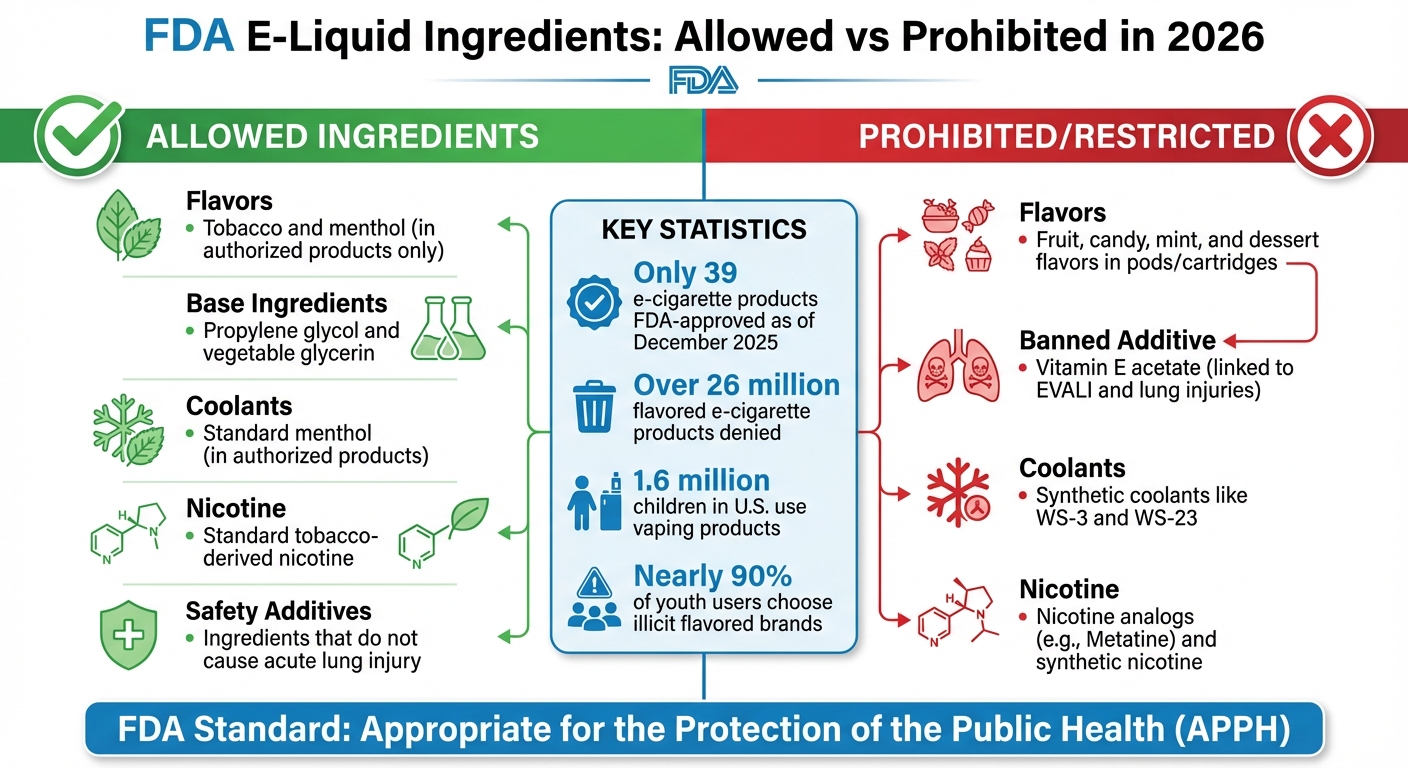
FDA Allowed vs Prohibited E-Liquid Ingredients 2026
The FDA has taken significant steps to limit the use of ingredients in e-liquids that could harm public health or attract underage users. These measures are part of a broader strategy aimed at reducing risks associated with vaping products. One notable example is Vitamin E acetate, which the CDC identified as a leading cause of severe respiratory illnesses and lung injuries during the 2019 EVALI outbreak. This additive was particularly prevalent in black-market THC cartridges.
The agency also targets flavored products due to their appeal to minors. By late 2025, the FDA had denied marketing applications for over 26 million flavored e-cigarette products. The reasoning? These products were found to attract youth while failing to demonstrate any public health benefits that outweighed the risks. On top of federal regulations, states like California and cities like Denver have introduced their own bans, targeting synthetic cooling agents like WS-3 and WS-23, as well as nicotine analogs such as Metatine.
Specific Prohibited Ingredients
The FDA's list of banned ingredients focuses on two primary concerns: direct health hazards and products that entice young users. One of the most prominent examples is Vitamin E acetate, which has been conclusively linked to lung injuries.
To further address youth vaping, the FDA has restricted flavors, allowing only tobacco or menthol in authorized products. As of December 2025, the agency had approved 39 e-cigarette devices under these strict guidelines. Despite these efforts, more than 1.6 million children in the U.S. still use vaping products, with nearly 90% of them choosing illicit flavored brands. These restrictions highlight the FDA's commitment to distinguishing between safe, compliant additives and those that pose significant risks.
Allowed vs. Prohibited Additives
The FDA evaluates additives based on scientific evidence, product type, and their potential impact on public health. Ingredients like propylene glycol and vegetable glycerin are still permitted in authorized products, while synthetic flavors and additives designed to appeal to youth face strict limitations.
| Feature | Allowed | Restricted |
|---|---|---|
| Flavors | Tobacco and menthol (in authorized products) | Fruit, candy, mint, and dessert flavors in pods/cartridges |
| Coolants | Standard menthol (in authorized products) | Synthetic coolants like WS-3 and WS-23 |
| Nicotine | Standard tobacco-derived nicotine | Nicotine analogs (e.g., Metatine) and synthetic nicotine |
| Safety Additives | Ingredients that do not cause acute lung injury | Vitamin E acetate, linked to EVALI and lung injury |
The FDA uses a rigorous standard called "Appropriate for the Protection of the Public Health" to assess each ingredient. This evaluation weighs the potential benefits for adult smokers against the risks of youth usage. Manufacturers are required to meet these strict criteria to ensure their products remain compliant and safe for consumers.
FDA Enforcement Actions on Flavored E-Liquids
Since 2020, the FDA has taken extensive actions against flavored e-liquids, issuing Marketing Denial Orders for over 1 million flavored products and rejecting nearly all of the 26 million tobacco product applications submitted during this time. These moves have sparked detailed product denials and, in many cases, legal challenges.
Denied Product Applications
In August 2021, the FDA launched a significant enforcement effort targeting flavored e-liquids. Around 55,000 applications were denied from companies like JD Nova Group LLC and Great American Vapes for flavors such as "Apple Crumble" and "Cinnamon Toast Cereal". By May 2023, the scope of denials had widened to include approximately 6,500 products from 10 more companies. Later that year, in October, six Vuse Alto "Mixed Berry" variants were also rejected.
"Science is a cornerstone of FDA's tobacco product review process. Today's decision to deny approximately 6,500 products was based on the lack of scientific evidence provided in the applications."
– Matthew Farrelly, Ph.D., Director of the Office of Science within FDA's Center for Tobacco Products
The FDA's requirements remain consistent: manufacturers must present solid scientific evidence - typically through randomized controlled trials or longitudinal studies - proving that their flavored products provide a net public health benefit. This means showing that benefits for adult smokers outweigh the risks to youth. By early 2025, no flavored product had met these rigorous standards, with only 39 tobacco- and menthol-flavored products gaining authorization.
Legal Challenges and Industry Response
The vaping industry has fought back against these denials, taking the FDA to court over what they see as shifting standards. Companies like Triton Distribution and Vapetasia argued that the FDA changed its scientific requirements mid-review, calling the process "arbitrary and capricious". Initially, the 5th U.S. Circuit Court of Appeals sided with the industry in a 10-6 vote, citing flaws in the FDA's review process.
However, in April 2025, the U.S. Supreme Court reversed that decision unanimously in a landmark ruling authored by Justice Samuel Alito. The case centered on denied applications for flavors like "Pink Lemonade", "Crème Brulee", and "Suicide Bunny Mother's Milk and Cookies." Justice Alito clarified:
"Affected parties may have come away with the impression that the agency would apply a less demanding standard of proof than is evident in the denial orders the FDA ultimately issued... in the end, we cannot say that the FDA improperly changed its position with respect to scientific evidence."
– Samuel Alito, Associate Justice, U.S. Supreme Court
"Triton and Vapetasia maintain that their products reduce harm for cigarette smokers."
– Eric Heyer, Attorney for Triton Distribution and Vapetasia
While the Supreme Court upheld the FDA's authority, it did send one narrow issue back to lower courts to evaluate whether the FDA adequately considered manufacturers' plans to restrict youth access. Despite this, the ruling largely ended years of legal uncertainty, reinforcing the FDA's position. Seven other federal appellate courts had already ruled in favor of the FDA, further solidifying its stance.
sbb-itb-5630951
2026 FDA Regulations on E-Liquid Ingredients
The FDA has established a stringent regulatory framework for e-liquids, creating a challenging compliance environment for manufacturers. As of now, only 39 e-cigarette products and devices have been approved for legal sale in the United States. These approvals are limited to tobacco and menthol flavors. Notably, no fruit, candy, or dessert flavors have passed the agency's rigorous scientific evaluation. This approach emphasizes safety and restricts products likely to attract younger users.
Restrictions on Flavored and Menthol E-Liquids
In 2026, the FDA remains focused on curbing the availability of unauthorized flavored disposable vapes, particularly those appealing to youth. The statistics are concerning: 97% of youth e-cigarette users report using flavored products, and 70% say flavors are their main reason for vaping. This crackdown has expanded from the initial 2020 restrictions on closed cartridge systems to include disposable devices, which saw a dramatic rise in market share - from 24.7% in early 2020 to 52% by late 2022.
Manufacturers using synthetic nicotine are now held to the same standards as those using tobacco-derived nicotine. This includes Pre-Market Tobacco Application (PMTA) submissions and meeting identical public health benchmarks. To enforce these rules, regulators have ramped up measures like port seizures and warning letters, targeting illegal flavored disposables such as Elf Bar and Esco Bar to prevent their entry into U.S. markets.
Enhanced Safety and Labeling Standards
Beyond flavor restrictions, the FDA has tightened safety and labeling requirements. All e-liquids must now meet the "Appropriate for the Protection of the Public Health" (APPH) standard, which involves detailed toxicological evaluations of aerosolized products. Labeling regulations mandate the inclusion of the warning: "WARNING: This product contains nicotine. Nicotine is an addictive chemical". Additional warnings about accidental nicotine exposure are also recommended.
Child-resistant packaging is now mandatory, and manufacturers must provide comprehensive documentation detailing their manufacturing processes, quality control measures, and full ingredient lists, including the type of nicotine and flavorings used. These measures are critical, especially after studies revealed discrepancies in product labeling. For instance, nicotine concentrations in e-liquids were found to be, on average, 18.7% lower than stated, while propylene glycol levels were 4.3% below the labeled values.
How Manufacturers Can Meet FDA Requirements
Navigating FDA standards involves meticulous preparation and a commitment to maintaining high-quality practices throughout production. From submitting detailed applications to following strict manufacturing protocols, manufacturers must stay on top of these requirements to ensure compliance.
PMTA Submissions and Documentation
The Pre-Market Tobacco Application (PMTA) process starts with setting up a CTP Portal NextGen account for electronic submissions. Manufacturers must also request an Industry Account Manager (IAM) account to complete this process. Beginning January 2, 2026, all PMTA submissions must use the latest versions of Form FDA 4057 and Form FDA 4057a.
"Starting Jan. 2, 2026, applicants must use these forms in their PMTA submissions. If applicants do not use the latest version of the forms or do not complete them properly, FDA generally intends to refuse to accept the application."
Each PMTA submission must include a comprehensive list of components, ingredients, and additives, along with detailed manufacturing descriptions. Manufacturers can group similar products using Form FDA 4057b, but each product still requires its own environmental assessment. At the heart of every application is scientific evidence proving the product is "appropriate for the protection of the public health."
For small businesses that may encounter challenges during this process, the FDA's CTP Office of Small Business Assistance offers support via email at smallbiz.tobacco@fda.hhs.gov.
The application process consists of three main review stages:
- Acceptance Review: A preliminary check to ensure basic statutory requirements are met.
- Filing Review: A deeper dive into whether the application is complete.
- Substantive Review: A thorough scientific evaluation.
The FDA is obligated to act on complete applications within 180 days. These steps highlight the agency's focus on ensuring thorough review and product safety.
Manufacturing Quality Standards
Beyond PMTA documentation, manufacturers must adhere to rigorous quality standards to maintain compliance.
All manufacturing facilities must register their establishments and provide product lists when operations begin, followed by annual updates submitted by December 31. Written protocols are essential to prevent microbial contamination, especially for products intended for aerosolization. Equipment must be clearly identified, and cleaning logs should be maintained to avoid cross-contamination between batches.
Consistent quality requires validated processes across the product lifecycle. Sampling of components, containers, and closures must be conducted under controlled conditions, with clear procedures in place for testing and for approving or rejecting each lot.
It's important to note that retail establishments that mix e-liquids or modify devices are classified as tobacco product manufacturers. This means they must comply with all PMTA and manufacturing regulations as well.
Conclusion
Key Points and Compliance Recommendations
The FDA framework is designed to ensure that only products meeting strict PMTA standards - demonstrating safety for public health - are allowed on the market. This process involves detailed ingredient disclosures, toxicological evaluations, and proof that the benefits for adult smokers outweigh the risks to youth and non-users.
Statistics emphasize the FDA's rigorous oversight, with only a limited number of products gaining authorization.
Failing to comply with these standards carries serious legal consequences. Products marketed without FDA authorization are classified as "adulterated" and "misbranded", making their sale illegal. Enforcement actions can include warning letters, civil penalties, product seizures, and injunctions. To confirm product authorization, retailers and consumers can use the FDA's Searchable Tobacco Products Database.
Manufacturers and vape shops that mix e-liquids must comply with PMTA requirements, register through the FDA Unified Registration and Listing System (FURLS), and maintain high manufacturing quality standards. Compliance not only fulfills legal obligations but also protects public health. The FDA's Center for Tobacco Products Office of Small Business Assistance (smallbiz.tobacco@fda.hhs.gov) offers guidance for small businesses navigating these regulations.
As the industry evolves, enforcement efforts are prioritizing flavored products that appeal to youth and those lacking proper authorization. Staying informed about regulatory updates, maintaining thorough documentation, and using child-resistant packaging are critical for compliance. Given that tobacco use remains the leading preventable cause of disease and death in the United States, these regulations play an essential role in safeguarding public health.
At Fresh Farms E-Liquid (https://freshfarmseliquid.com), we are committed to meeting these stringent standards to ensure the highest levels of safety and quality.
FAQs
What happens if a company doesn’t comply with FDA regulations for e-liquid ingredients?
Non-compliance with FDA regulations regarding e-liquid ingredients can result in severe repercussions. These may range from receiving warning letters and having products seized to facing fines or legal action. To steer clear of these enforcement measures, companies need to ensure their products align with FDA standards.
Staying informed about regulatory updates and adhering to compliance protocols isn’t just about avoiding penalties - it’s about safeguarding product quality and earning consumer trust.
Why does the FDA only approve tobacco and menthol e-liquid flavors?
The FDA has approved only tobacco and menthol e-liquid flavors, as these align with the agency's public health standards. These flavors are seen as less enticing to young people, which helps lower the chances of underage vaping. In contrast, other flavors, often perceived as more appealing to youth, have been rejected to address the growing concerns surrounding youth vaping and its potential dangers.
How does the FDA ensure the safety of e-liquid ingredients?
The FDA plays a key role in ensuring the safety of e-liquid ingredients by requiring manufacturers to submit comprehensive ingredient details for review. This is a crucial step in the FDA’s pre-market evaluation process for electronic nicotine delivery systems (ENDS), aimed at identifying potential risks and confirming compliance with established safety standards.
To meet these requirements, manufacturers must use the FDA’s electronic submission system to provide a complete list of the ingredients in their e-liquids. This process promotes transparency and enables the FDA to determine whether these products align with regulations designed to safeguard public health.


