

Purity testing for e-liquid ingredients like Vegetable Glycerin (VG) and Propylene Glycol (PG) is non-negotiable for safety and quality. These two compounds form the base of e-liquids, delivering nicotine and flavor when vaporized. However, contaminants such as ethylene glycol (EG) and diethylene glycol (DEG) can pose serious health risks, including kidney and liver damage. Regulatory bodies like the FDA and USP enforce strict safety limits of 0.1% (1 mg/g) for these toxins.
Here’s how manufacturers ensure VG and PG meet safety and performance standards:
- Advanced Testing Methods: Techniques like Gas Chromatography-Flame Ionization Detection (GC-FID) and Gas Chromatography-Mass Spectrometry (GC-MS) are used to detect and quantify impurities.
- Physical Property Checks: Tests for boiling point, density, and refractive index confirm ingredient consistency.
- USP-Grade Standards: Ingredients must meet pharmaceutical-grade purity of at least 99.5%, verified by rigorous testing.
High-purity VG and PG not only safeguard consumers but also improve flavor, vapor production, and overall vaping experience. Manufacturers, like Fresh Farms E-Liquid, adhere to these standards to ensure safe and quality products.
Testing Methods for VG and PG Purity
Ensuring the purity of Vegetable Glycerin (VG) and Propylene Glycol (PG) is critical for producing high-quality e-liquids. Advanced analytical techniques play a key role in maintaining these standards.
Gas Chromatography with Flame Ionization Detection (GC-FID)
Gas Chromatography-Flame Ionization Detection (GC-FID) is widely regarded as the gold standard for assessing the purity of VG and PG. This method, endorsed by both the U.S. FDA and the United States Pharmacopeia (USP), separates and vaporizes the sample components, ionizing them in a hydrogen flame. The resulting signal directly correlates to the concentration of each component.
GC-FID is particularly reliable for routine purity checks, as it can accurately measure major components and detect contaminants at levels as low as 0.1% (w/w). Its validation as an industry-standard method ensures that VG and PG meet stringent pharmaceutical-grade requirements.
Gas Chromatography-Mass Spectrometry (GC-MS) for Glycol Impurities
Gas Chromatography-Mass Spectrometry (GC-MS) is another powerful tool, especially for identifying impurities like diethylene glycol (DEG) and ethylene glycol (EG). By ionizing molecules and analyzing their mass-to-charge ratios, GC-MS provides precise identification of contaminants. A 2020 study involving 30 laboratories confirmed that GC-MS delivers accuracy and precision comparable to GC-FID.
For even more detailed analysis, Isotope Dilution GC-MS/MS is employed. This method uses isotopically labeled standards to enhance sensitivity and selectivity. In 2021, the CDC's Tobacco Products Laboratory used this technique to examine 141 vaping products tied to the 2019 EVALI outbreak. The results confirmed that none of the nicotine-containing products exceeded the 0.1% safety threshold for EG or DEG. These advanced methods go beyond traditional screening, offering the precision needed to detect even trace impurities that could pose health risks.
USP Monograph Methods for Pharmaceutical-Grade Verification
The United States Pharmacopeia-National Formulary (USP-NF) sets official standards for VG and PG purity. Its monograph employs techniques like infrared absorption and gas chromatography to verify identity and measure impurity levels. According to FDA guidelines:
A drug, including a drug component, with a name recognized in the United States Pharmacopeia-National Formulary (USP-NF) must comply with compendial identity standards or be deemed adulterated, misbranded, or both.
The USP mandates that DEG and EG levels must remain below 0.10%. Manufacturers cannot simply rely on supplier Certificates of Analysis; they are required to conduct USP identity tests on representative samples from every shipment and lot. This rigorous process helps prevent contaminated materials from entering the e-liquid supply chain - a critical safeguard highlighted by DEG poisoning incidents that tragically caused over 300 deaths in 2022 and 2023. These methods underscore the industry's commitment to maintaining pharmaceutical-grade standards for VG and PG purity.
sbb-itb-5630951
Physical Property Testing for VG and PG
To ensure the quality and consistency of vegetable glycerin (VG) and propylene glycol (PG), manufacturers conduct physical property tests alongside chemical analyses. These tests provide an additional layer of verification, identifying potential contaminants and confirming ingredient performance. Key methods include boiling point determination, density measurement, and refractive index testing. Together, these tests act as an initial quality checkpoint, ensuring raw materials meet production standards.
Measuring Boiling Point and Density
After chemical analysis, physical property tests help confirm the consistency of materials. One important test is boiling point measurement, which follows the "Distillation Range" method outlined in ASTM E202-18 (Sections 10–12). This method evaluates the thermal profile of propylene glycol to verify its identity and purity. Automated digital boiling point meters are commonly used for precision and efficiency.
Density testing is another critical step, as it helps control PG/VG concentrations, which directly affect flavor and vaporization. These measurements are conducted at standardized temperatures in accordance with USP, FCC, and European Pharmacopoeia guidelines. Digital density meters are preferred due to their accuracy and quick results.
The ASTM E202-18 standard provides clear protocols for both boiling point (Sections 10–12) and density (Sections 6–8) measurements, ensuring uniformity across the industry.
Testing Refractive Index
Refractive index testing is a fast and effective way to assess PG/VG ratios. By measuring how light bends as it passes through a liquid, this method can determine the ratio of PG to VG in a mixture. This ensures the proper balance of ingredients.
Modern laboratories often use multiparameter systems that can simultaneously measure refractive index, density, pH, and UV/VIS color. These systems streamline the quality control process, making it more efficient. While physical property tests are excellent for assessing concentration, they work best when paired with advanced techniques like GC-MS to detect trace impurities.
Comparison of Testing Methods
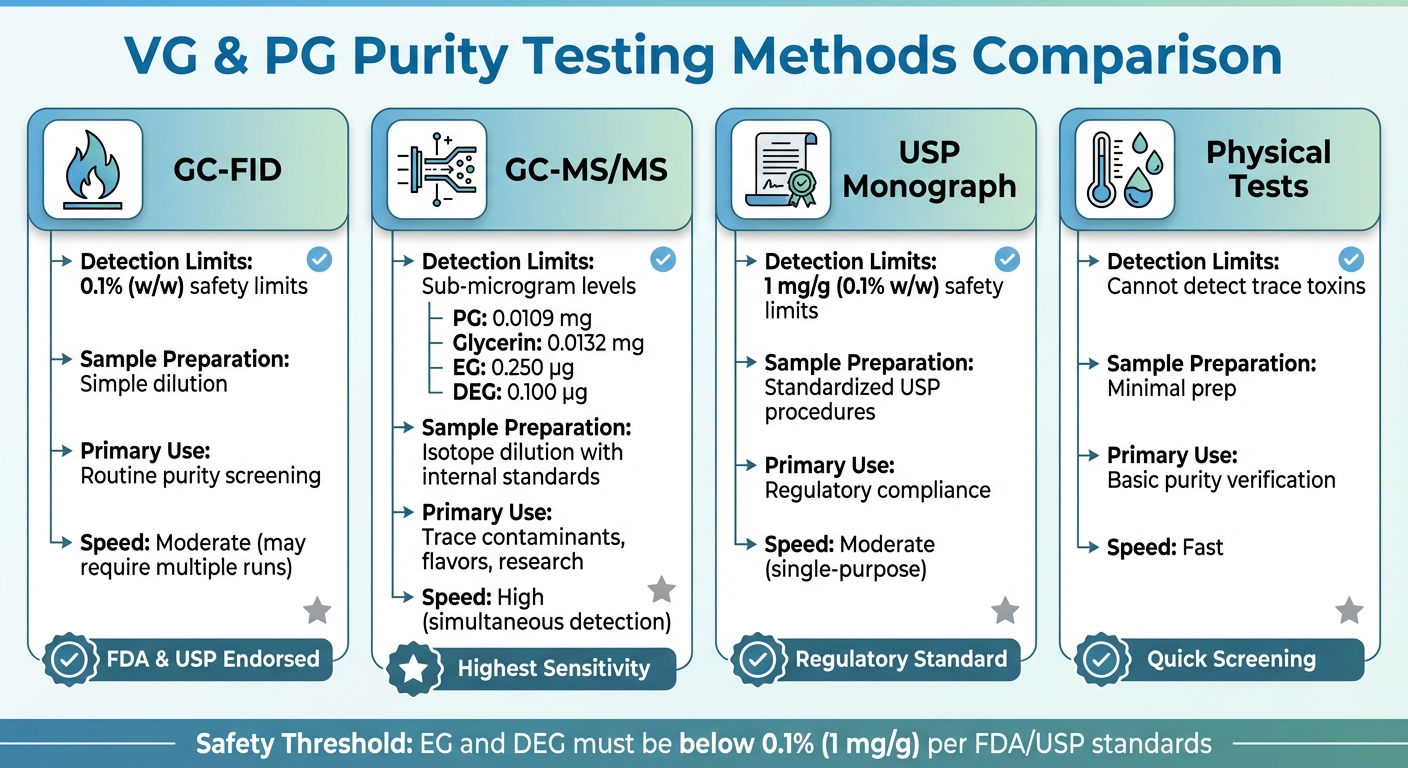
VG and PG Testing Methods Comparison: Detection Limits and Applications
Testing Methods Comparison Table
Ensuring the purity of VG (vegetable glycerin) and PG (propylene glycol) while identifying trace impurities is a critical part of quality assurance. Different testing methods offer unique benefits, helping manufacturers choose the most effective approach for their needs. These methods balance factors like speed, sensitivity, and compliance with regulatory standards.
GC-FID is widely regarded as the go-to method for routine screening, endorsed by both the USFDA and USP. It effectively identifies ethylene glycol (EG) and diethylene glycol (DEG) at the safety threshold of 1 mg/g (0.1% w/w). The process involves simple sample dilution, making it relatively straightforward. However, confirming and quantifying contamination often requires two separate analytical runs.
GC-MS and GC-MS/MS excel in detecting trace contaminants with remarkable sensitivity. They can identify contaminants at sub-microgram levels: 0.0109 mg for PG, 0.0132 mg for glycerin, 0.250 µg for EG, and 0.100 µg for DEG. The CDC's Tobacco Products Laboratory highlights the efficiency of the ID-GC-MS/MS method, which not only quantifies PG and glycerin concentrations but also screens for EG and DEG in a single sample. A collaborative study across 30 laboratories found an almost perfect correlation (Pearson's r ≈ 1) between results from GC-FID and GC-MS for major e-liquid components.
The table below outlines the key features of these testing methods:
| Method | Detection Limits | Sample Preparation | Primary Use | Speed |
|---|---|---|---|---|
| GC-FID | 0.1% (w/w) safety limits | Simple dilution | Routine purity screening | Moderate (may require multiple runs) |
| GC-MS/MS | Sub-microgram levels | Isotope dilution with internal standards | Trace contaminants, flavors, research | High (simultaneous detection) |
| USP Monograph | Defined by safety limits (1 mg/g) | Standardized USP procedures | Regulatory compliance | Moderate (single-purpose) |
| Physical Tests | Cannot detect trace toxins | Minimal prep | Basic purity verification | Fast |
Physical property tests, such as boiling point and density measurements, offer a quick and easy way to verify basic purity. However, they are not capable of detecting trace toxins, making GC-MS essential for more detailed analysis.
Conclusion: VG and PG Purity for Better E-Liquids
Ensuring the purity of VG (vegetable glycerin) and PG (propylene glycol) is a critical step in producing safe and high-quality e-liquids. Beyond meeting regulatory requirements, purity testing plays a direct role in protecting consumers from harmful contaminants. Substances like ethylene glycol (EG) and diethylene glycol (DEG), which are toxic to the kidneys and liver, must be carefully monitored. The USFDA and USP have set a strict safety threshold of 1 mg/g (0.1% w/w) for these contaminants.
"Although PG and GLY exposure via oral and dermal routes appear to be innocuous, little is known of the long-term health consequences of inhaled PG and GLY from sources such as EVPs."
– José J. Pérez, Clifford H. Watson, Benjamin C. Blount, and Liza Valentín-Blasini
Using USP-grade ingredients with a purity level of at least 99.5% significantly reduces potential risks. High-purity VG and PG not only enhance the vaping experience - offering consistent throat hits, rich flavors, and dense vapor - but also prevent issues like irritation and chemical instability caused by impurities. Fresh Farms E-Liquid prioritizes these standards by carefully selecting premium ingredients and employing rigorous testing to ensure every product meets strict safety guidelines.
Key Takeaways
- Purity testing is essential to shield consumers from harmful byproducts that may arise during manufacturing.
- Advanced techniques like GC-MS/MS can detect contaminants at trace levels, while GC-FID offers reliable routine screening at the 0.1% safety limit.
- Quick physical property tests (e.g., boiling point, density, refractive index) are helpful but lack the sensitivity to identify trace toxins, making advanced chromatography indispensable.
- Manufacturers should rely on USP-grade VG and PG to meet stringent purity requirements.
- Regular monitoring for EG and DEG contamination is crucial to prevent unsafe raw materials from entering the supply chain.
FAQs
Why is testing the purity of VG and PG in e-liquids important?
Testing the purity of vegetable glycerin (VG) and propylene glycol (PG) in e-liquids plays a key role in maintaining both safety and quality. It helps identify harmful substances like ethylene glycol or diethylene glycol, which could pose serious health risks if present.
Equally important, confirming the correct concentration of VG and PG ensures a consistent vaping experience by balancing flavor, vapor production, and overall performance. This process safeguards consumers while meeting stringent quality standards, demonstrating a strong dedication to safety and reliability.
How is the purity of VG and PG in e-liquids tested?
The purity of vegetable glycerin (VG) and propylene glycol (PG) in e-liquids is assessed using precise scientific techniques. Two widely used methods are gas chromatography with mass spectrometry (GC-MS) and gas chromatography with flame-ionization detection (GC-FID). These techniques are designed to detect and measure impurities, ensuring the ingredients meet strict quality and safety requirements.
At Fresh Farms E-Liquid, we take quality and safety seriously. Every ingredient undergoes thorough testing to guarantee a premium vaping experience you can trust.
How do physical and chemical tests ensure the quality of e-liquids?
Physical testing plays a crucial role in evaluating the properties of propylene glycol (PG) and vegetable glycerin (VG), two key ingredients in e-liquids. These tests measure attributes like boiling point, viscosity, color, and consistency to ensure the e-liquid performs as expected in vape devices. For instance, stability tests check if the liquid maintains uniformity under different conditions, such as temperatures ranging from 70°F to 122°F. This ensures reliability in terms of cloud production, flavor delivery, and overall stability.
On the chemical side, advanced analyses help identify the precise composition of the e-liquid and detect any unwanted contaminants. Techniques like gas chromatography and high-performance liquid chromatography (HPLC) are used to verify the purity of PG and VG, confirm nicotine levels, and screen for impurities. When combined, these physical and chemical evaluations guarantee that Fresh Farms E-Liquid products consistently meet strict standards for safety, performance, and quality.


