
Child-resistant packaging is essential for preventing children under five from accessing liquid nicotine, which can be life-threatening even in small amounts. Between 2010 and 2014, e-liquid exposure cases in the U.S. increased dramatically, with nearly half involving children under six. To address this risk, the Child Nicotine Poisoning Prevention Act (CNPPA) mandates safety measures for liquid nicotine containers. Key features include:
- Push-and-Turn Caps: Require simultaneous actions to open, challenging for children but accessible to adults.
- Tamper-Evident Seals: Provide visible proof of product integrity, ensuring safety before use.
- Child-Resistant Zippers: Used in flexible packaging, requiring multiple steps to open.
- Restricted Flow Design: Limits liquid release to no more than 2 mL when inverted.
These designs comply with U.S. regulations and undergo rigorous testing to ensure effectiveness. By prioritizing safety, manufacturers not only meet legal standards but also help reduce poisoning incidents among children.
Why E-Liquids Need Child-Resistant Packaging
Health Risks of Nicotine for Children
Liquid nicotine is highly dangerous for young children due to their smaller body size and lack of tolerance. Even a small amount can have life-threatening effects. And it’s not just swallowing the liquid that’s risky - nicotine can also be absorbed through the skin, leading to poisoning.
Between April 2022 and March 2023, poison control centers reported 7,043 cases of e-cigarette or e-liquid exposure, with nearly 88% involving kids under the age of five. Symptoms of nicotine poisoning can range from nausea and vomiting to more severe outcomes like seizures, cardiac arrest, or even coma. Open systems that require manual refilling increase the danger by exposing children to concentrated nicotine.
These alarming health risks make strict regulations absolutely necessary.
U.S. Regulatory Requirements
The Child Nicotine Poisoning Prevention Act (CNPPA), introduced in January 2016, requires all liquid nicotine containers sold, manufactured, or imported in the U.S. to feature child-resistant packaging. According to 16 CFR § 1700.15, this packaging must be designed to prevent children under five from opening it within a reasonable amount of time.
The U.S. Consumer Product Safety Commission (CPSC) oversees these packaging requirements, while the FDA regulates e-liquids as tobacco products under the 2016 "Deeming Rule." Manufacturers are required to provide a General Certificate of Compliance (GCC), which certifies that their packaging meets all safety standards following proper testing. Failure to comply is considered a misbranding violation under the Federal Food, Drug, and Cosmetic Act. Penalties for violations can include hefty fines, product recalls, and even imprisonment - even if no injuries have occurred.
There are some exceptions: sealed, pre-filled, and disposable cartridges used in closed-system e-cigarettes are not subject to CNPPA rules as long as the nicotine remains inaccessible during normal use. However, refillable bottles must meet a restricted flow standard, ensuring that no more than 2 mL of liquid can be dispensed when the container is inverted and squeezed or activated.
Unpacked: Examples of Child Resistant Packaging
Key Features of Child-Resistant E-Liquid Packaging
Child-resistant packaging is designed with specific mechanisms to prevent young children from accessing potentially harmful substances. These features must strike a balance - challenging enough to deter children but still manageable for adults. Let’s break down how these safety mechanisms work.
Push-and-Turn Caps
Push-and-turn caps are one of the most common child-resistant closures in the e-liquid industry. These caps require users to push down and twist simultaneously to open them. Studies show that 85% of children under five struggle to complete this action within five minutes, while 90% of adults aged 50 to 70 can open and resecure them without difficulty.
The materials used for these caps must withstand prolonged contact with e-liquids, as substances like nicotine and solvents can degrade certain plastics over time. Manufacturers need to ensure the locking mechanism remains functional throughout the product's lifespan. This approach not only meets regulatory requirements but also ensures the product remains user-friendly for adults.
Flexible packaging utilizes similar principles, incorporating closures that require multiple actions to enhance safety.
Child-Resistant Zippers and Closures
For flexible packaging, such as pouches, child-resistant zippers provide an effective alternative to rigid caps. These closures often involve multiple steps, like pressing a tab, aligning specific markers, or using a squeeze-and-slide motion. These actions are straightforward for adults but challenging for children.
A key advantage of these closures is their ability to maintain the same level of security after being opened and resealed. This ensures safety throughout the product's usage, not just at the first opening. Additionally, the materials used must resist punctures and accidental damage during storage or transport to prevent leaks. Many manufacturers also print clear instructions and warnings directly on the packaging to help adults use the closures correctly while discouraging tampering by children. These features enhance both compliance with safety standards and consumer trust.
In addition to these closures, tamper-evident features provide an extra layer of protection for product integrity.
Tamper-Evident Seals and Lids
While child-resistant mechanisms focus on preventing access, tamper-evident features ensure the product hasn’t been compromised before purchase. These seals provide visible proof of integrity, with common designs including drop bands (plastic rings that break away from the cap), tear-off tabs, and foil seals that must be removed to access the contents.
"Plastic tamper evident closures and caps give consumers peace of mind on your product's integrity at the shelf." - BottleStore.com
Before using a product, it’s important to inspect these seals. A broken drop band or peeling foil could indicate tampering. These visual safeguards build consumer confidence, ensuring the e-liquid inside matches the manufacturer’s quality standards. Together, tamper-evident seals and child-resistant closures create multiple layers of protection, providing both safety and reassurance.
sbb-itb-5630951
Testing Standards for Child-Resistant Packaging
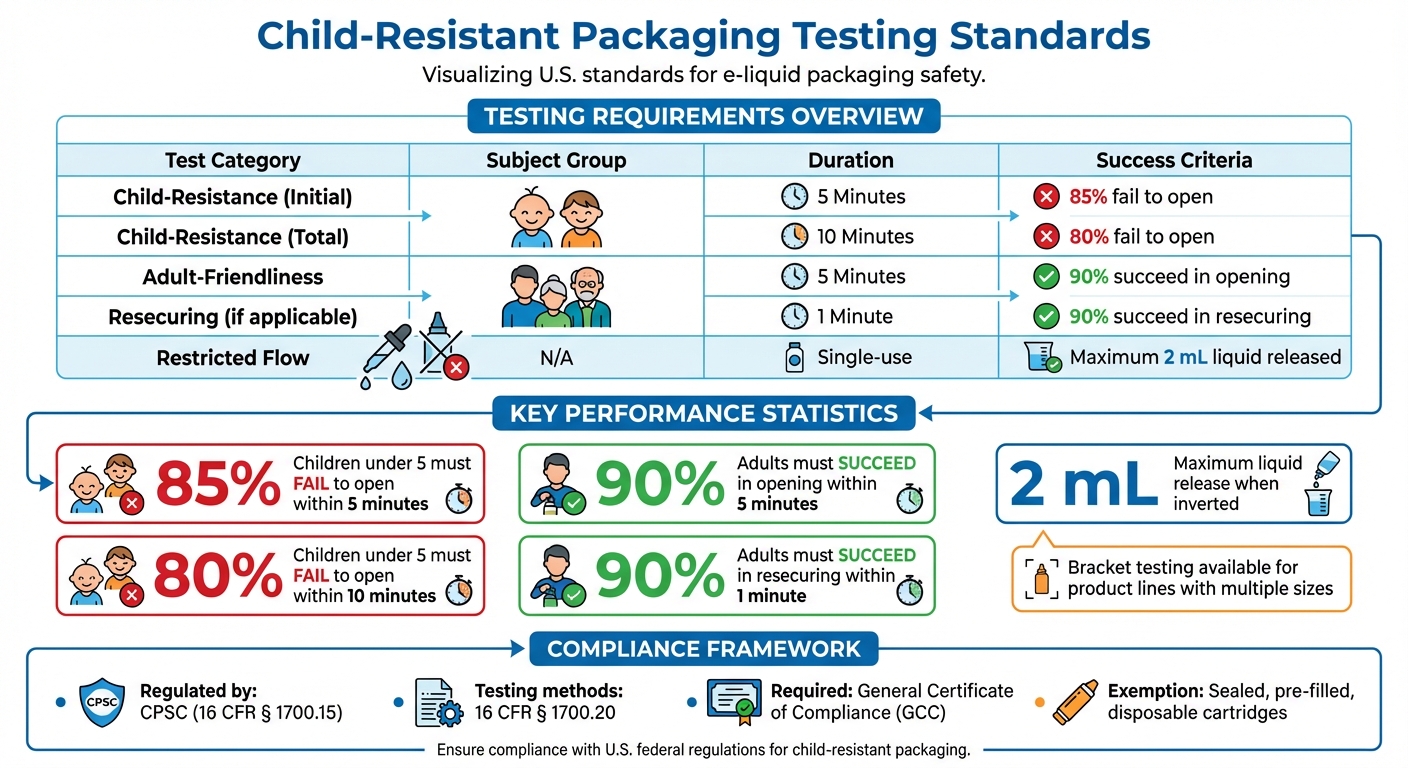
Child-Resistant E-Liquid Packaging Testing Standards and Requirements
How Testing Ensures Safety
To ensure child-resistant packaging works as intended, rigorous testing evaluates its effectiveness in keeping children out while remaining easy for adults to use. The Consumer Product Safety Commission (CPSC) defines "special packaging" as containers that are hard for children under five years old to open but still accessible for adults. Testing involves two groups: children and adults. For certification, at least 85% of children under five must fail to open the package within five minutes (and 80% within ten minutes). At the same time, 90% of adults must be able to open the package within five minutes and reseal it within one minute if required. These benchmarks ensure the packaging performs reliably under controlled conditions.
In addition to these tests, e-liquid packaging must pass a restricted flow test. This means that when inverted and activated, the container can release no more than 2 mL of liquid. These standards apply to all container types undergoing testing.
U.S. Compliance Standards
Under the Child Nicotine Poisoning Prevention Act (CNPPA) of 2016, all liquid nicotine containers must comply with the safety standards detailed in 16 CFR § 1700.15, using the testing methods outlined in 16 CFR § 1700.20. Before selling or distributing these products in the U.S., manufacturers must issue a General Certificate of Compliance (GCC) based on successful test results. This certificate confirms that the packaging has passed all required safety evaluations.
| Test Category | Subject Group | Duration | Success Criteria |
|---|---|---|---|
| Child-Resistance (Initial) | Children under 5 | 5 Minutes | 85% fail to open |
| Child-Resistance (Total) | Children under 5 | 10 Minutes | 80% fail to open |
| Adult-Friendliness | Adults/Seniors | 5 Minutes | 90% succeed in opening |
| Resecuring (if applicable) | Adults/Seniors | 1 Minute | 90% succeed in resecuring |
| Restricted Flow | N/A | Single use | Maximum of 2 mL liquid released |
For product lines with multiple bottle sizes, manufacturers can use bracket testing. This involves testing the smallest and largest bottles to certify the entire range. However, any changes to packaging materials, manufacturing processes, or closure–bottle combinations require retesting and recertification. Retailers are encouraged to request a GCC for every liquid nicotine product they stock to ensure compliance. Notably, sealed, pre-filled, disposable cartridges where the liquid nicotine is inaccessible are exempt from CNPPA requirements.
Benefits of Child-Resistant Packaging for E-Liquids
Child-resistant packaging does far more than just tick regulatory boxes - it plays a vital role in ensuring safety, earning consumer trust, and safeguarding a brand's reputation.
Building Consumer Trust and Safety
Child-resistant packaging provides an essential layer of protection, especially when designed to meet federal standards that prevent most children from opening these containers. This added safety is crucial, given the thousands of exposure cases reported each year. By prioritizing such packaging, brands send a clear message: they care about their customers' well-being. This attention to safety not only protects families but also builds confidence in the product.
Compliance and Brand Reputation
Following the Child Nicotine Poisoning Prevention Act (CNPPA) is about more than just legal compliance - it's a statement of responsibility. By securing a General Certificate of Compliance (GCC), manufacturers demonstrate that their packaging aligns with 16 CFR § 1700.15 standards. This ensures products are not misbranded under federal law. Compliance shows a commitment to safety, which in turn strengthens the brand's reputation and fosters long-term trust among consumers.
Fresh Farms E-Liquid's Commitment to Safety
Fresh Farms E-Liquid exemplifies this dedication to safety. Across its product lines, including FRUITIA and Fifty Bar, the company adheres to strict federal packaging standards. Every e-liquid container undergoes rigorous testing to meet Consumer Product Safety Commission (CPSC) protocols, ensuring child-resistant features remain effective throughout the product's usage. This unwavering focus on safety underscores Fresh Farms' mission to prioritize customer satisfaction and trust at every step.
Conclusion
Child-resistant packaging plays a critical role in safeguarding children from potentially fatal nicotine exposure. Recent cases highlight the dangers, showing that even a small amount of nicotine can be deadly for young children.
The most effective packaging solutions incorporate features like push-and-turn caps, tamper-evident seals, and restricted flow designs. These elements are carefully designed to meet strict federal safety standards, striking a balance between preventing access by children and remaining practical for adult use. Adhering to these standards is a key step in ensuring product safety and protecting families.
"Child-resistant packaging was one of 'the best documented successes in preventing child poisoning in the developed world'." - World Health Organization (WHO)
Companies like Fresh Farms E-Liquid demonstrate a strong commitment to safety by prioritizing rigorous testing and full compliance with federal regulations. Across product lines such as FRUITIA and Fifty Bar, every container is meticulously tested to ensure child-resistant features remain effective throughout its use. This unwavering focus on safety not only protects families but also fosters trust in their products.
FAQs
Why is child-resistant packaging important for e-liquids?
Child-resistant packaging plays a crucial role in keeping young children safe by preventing them from accidentally opening and ingesting nicotine-containing e-liquids. Since even small amounts of nicotine can be extremely toxic to children, these safety measures significantly lower the risk of severe harm or, in some cases, fatal poisoning.
Beyond safety, child-resistant packaging also ensures compliance with federal regulations, setting a standard for accountability in the vaping industry. Companies like Fresh Farms E-Liquid showcase their dedication to protecting families by adhering to these safety standards while continuing to provide top-tier products.
What are the key safety features of child-resistant packaging for e-liquids?
Child-resistant packaging for e-liquids plays a crucial role in reducing the risk of accidental exposure to nicotine by children. To meet federal safety standards set by the Child Nicotine Poisoning Prevention Act, these packages often use features like push-and-turn caps or double-lock mechanisms. These designs are intentionally challenging for children to open while remaining manageable for adults.
This regulation specifically targets refillable bottles containing nicotine, ensuring safer handling and storage. On the other hand, sealed, pre-filled disposable vape products are usually exempt from these rules. By focusing on secure packaging, companies such as Fresh Farms E-Liquid demonstrate their commitment to protecting consumers and their families.
What regulations ensure the safety of e-liquid packaging in the U.S.?
To keep children safe from accidental nicotine poisoning, U.S. regulations mandate child-resistant packaging for all liquid nicotine containers, including e-liquids. The Child Nicotine Poisoning Prevention Act of 2015 requires that any nicotine-containing liquid sold or imported after July 26, 2016, complies with strict safety guidelines overseen by the Consumer Product Safety Commission (CPSC).
These guidelines ensure that the packaging is:
- Challenging for children to open but still user-friendly for adults.
- Sturdy and reliable, maintaining its protective features over time.
- Chemically compatible with the nicotine solution it contains.
Manufacturers are also required to test their packaging to meet specific safety standards, significantly lowering the chances of accidental ingestion. These measures aim to make e-liquid containers safer for households while ensuring they remain practical for adult users.


